 Add to Chrome
 Add to Firefox
 Add to Edge
MBench: A Comprehensive Benchmark on Memory Capability for Video World Models
May 30, 2026
Recent advancements in video-based world models have demonstrated an unprecedented ability to synthesize high-fidelity visual sequences. However, a fundamental gap persists between visually plausible video generation and the functional requirements of a world model, particularly in maintaining a stable and reasonable internal state over extended temporal horizons. While existing benchmarks primarily emphasize visual quality, motion coherence, and text-video alignment, they largely overlook memory, the core capability of a world model to preserve consistency across long-term horizons and complex interactions. To address this gap, we present \textbf{MBench}, a comprehensive benchmark dedicated to quantifying and evaluating the memory capability of video world models. We systematically decompose the memory capability of video world models into three hierarchical and complementary core dimensions: entity consistency, environment consistency, and causal consistency, which are further refined into 12 quantifiable sub-dimensions for comprehensive characterization of long-term memory. Our benchmark is built upon rigorously curated real-captured long videos, and evaluated by rule-based quantitative matrices and VLM to enable objective and comprehensive consistency assessment. Extensive evaluations of mainstream state-of-the-art video world models reveal critical systemic limitations of existing methods in long-term state retention, providing a standardized benchmark and clear research direction to advance the field.

Enhancing Spatial Understanding in Image Generation via Reward Modeling
Feb 27, 2026Recent progress in text-to-image generation has greatly advanced visual fidelity and creativity, but it has also imposed higher demands on prompt complexity-particularly in encoding intricate spatial relationships. In such cases, achieving satisfactory results often requires multiple sampling attempts. To address this challenge, we introduce a novel method that strengthens the spatial understanding of current image generation models. We first construct the SpatialReward-Dataset with over 80k preference pairs. Building on this dataset, we build SpatialScore, a reward model designed to evaluate the accuracy of spatial relationships in text-to-image generation, achieving performance that even surpasses leading proprietary models on spatial evaluation. We further demonstrate that this reward model effectively enables online reinforcement learning for the complex spatial generation. Extensive experiments across multiple benchmarks show that our specialized reward model yields significant and consistent gains in spatial understanding for image generation.
Scaling Speech Tokenizers with Diffusion Autoencoders
Feb 06, 2026Speech tokenizers are foundational to speech language models, yet existing approaches face two major challenges: (1) balancing trade-offs between encoding semantics for understanding and acoustics for reconstruction, and (2) achieving low bit rates and low token rates. We propose Speech Diffusion Tokenizer (SiTok), a diffusion autoencoder that jointly learns semantic-rich representations through supervised learning and enables high-fidelity audio reconstruction with diffusion. We scale SiTok to 1.6B parameters and train it on 2 million hours of speech. Experiments show that SiTok outperforms strong baselines on understanding, reconstruction and generation tasks, at an extremely low token rate of $12.5$ Hz and a bit-rate of 200 bits-per-second.
The Llama 4 Herd: Architecture, Training, Evaluation, and Deployment Notes
Jan 15, 2026This document consolidates publicly reported technical details about Metas Llama 4 model family. It summarizes (i) released variants (Scout and Maverick) and the broader herd context including the previewed Behemoth teacher model, (ii) architectural characteristics beyond a high-level MoE description covering routed/shared-expert structure, early-fusion multimodality, and long-context design elements reported for Scout (iRoPE and length generalization strategies), (iii) training disclosures spanning pre-training, mid-training for long-context extension, and post-training methodology (lightweight SFT, online RL, and lightweight DPO) as described in release materials, (iv) developer-reported benchmark results for both base and instruction-tuned checkpoints, and (v) practical deployment constraints observed across major serving environments, including provider-specific context limits and quantization packaging. The manuscript also summarizes licensing obligations relevant to redistribution and derivative naming, and reviews publicly described safeguards and evaluation practices. The goal is to provide a compact technical reference for researchers and practitioners who need precise, source-backed facts about Llama 4.
SCP: Accelerating Discovery with a Global Web of Autonomous Scientific Agents
Dec 30, 2025We introduce SCP: the Science Context Protocol, an open-source standard designed to accelerate discovery by enabling a global network of autonomous scientific agents. SCP is built on two foundational pillars: (1) Unified Resource Integration: At its core, SCP provides a universal specification for describing and invoking scientific resources, spanning software tools, models, datasets, and physical instruments. This protocol-level standardization enables AI agents and applications to discover, call, and compose capabilities seamlessly across disparate platforms and institutional boundaries. (2) Orchestrated Experiment Lifecycle Management: SCP complements the protocol with a secure service architecture, which comprises a centralized SCP Hub and federated SCP Servers. This architecture manages the complete experiment lifecycle (registration, planning, execution, monitoring, and archival), enforces fine-grained authentication and authorization, and orchestrates traceable, end-to-end workflows that bridge computational and physical laboratories. Based on SCP, we have constructed a scientific discovery platform that offers researchers and agents a large-scale ecosystem of more than 1,600 tool resources. Across diverse use cases, SCP facilitates secure, large-scale collaboration between heterogeneous AI systems and human researchers while significantly reducing integration overhead and enhancing reproducibility. By standardizing scientific context and tool orchestration at the protocol level, SCP establishes essential infrastructure for scalable, multi-institution, agent-driven science.
InvCoSS: Inversion-driven Continual Self-supervised Learning in Medical Multi-modal Image Pre-training
Dec 22, 2025Continual self-supervised learning (CSSL) in medical imaging trains a foundation model sequentially, alleviating the need for collecting multi-modal images for joint training and offering promising improvements in downstream performance while preserving data privacy. However, most existing methods still rely on replaying data from previous stages to prevent catastrophic forgetting, which compromises privacy and limits their applicability in real-world scenarios where data transfer across sites is often restricted. In this work, we propose InvCoSS, an inversion-driven continual self-supervised learning framework for medical multi-modal image pre-training. Specifically, after training on a previous task, InvCoSS inverts the pre-trained self-supervised model to generate synthetic images that approximate the original training distribution. These synthetic images are then combined with data from the new task for joint optimization, which effectively mitigates catastrophic forgetting while strictly adhering to the constraint of no access to previous real data. Furthermore, to improve the fidelity of synthetic images, we introduce a novel InvUNet with a multi-scale fusion architecture to restore both high- and low-frequency components of the inverted images. To enhance diversity and prevent mode collapse, we design a repulsive representation-learning mechanism that encourages a diverse feature space for synthetic images without class guidance. Extensive experiments across nine downstream tasks validate the effectiveness of InvCoSS, achieving performance comparable to or even superior to prior data-replay methods while significantly reducing storage requirements and eliminating data privacy constraints.
E-4DGS: High-Fidelity Dynamic Reconstruction from the Multi-view Event Cameras
Aug 13, 2025Novel view synthesis and 4D reconstruction techniques predominantly rely on RGB cameras, thereby inheriting inherent limitations such as the dependence on adequate lighting, susceptibility to motion blur, and a limited dynamic range. Event cameras, offering advantages of low power, high temporal resolution and high dynamic range, have brought a new perspective to addressing the scene reconstruction challenges in high-speed motion and low-light scenes. To this end, we propose E-4DGS, the first event-driven dynamic Gaussian Splatting approach, for novel view synthesis from multi-view event streams with fast-moving cameras. Specifically, we introduce an event-based initialization scheme to ensure stable training and propose event-adaptive slicing splatting for time-aware reconstruction. Additionally, we employ intensity importance pruning to eliminate floating artifacts and enhance 3D consistency, while incorporating an adaptive contrast threshold for more precise optimization. We design a synthetic multi-view camera setup with six moving event cameras surrounding the object in a 360-degree configuration and provide a benchmark multi-view event stream dataset that captures challenging motion scenarios. Our approach outperforms both event-only and event-RGB fusion baselines and paves the way for the exploration of multi-view event-based reconstruction as a novel approach for rapid scene capture.
GS2E: Gaussian Splatting is an Effective Data Generator for Event Stream Generation
May 21, 2025We introduce GS2E (Gaussian Splatting to Event), a large-scale synthetic event dataset for high-fidelity event vision tasks, captured from real-world sparse multi-view RGB images. Existing event datasets are often synthesized from dense RGB videos, which typically lack viewpoint diversity and geometric consistency, or depend on expensive, difficult-to-scale hardware setups. GS2E overcomes these limitations by first reconstructing photorealistic static scenes using 3D Gaussian Splatting, and subsequently employing a novel, physically-informed event simulation pipeline. This pipeline generally integrates adaptive trajectory interpolation with physically-consistent event contrast threshold modeling. Such an approach yields temporally dense and geometrically consistent event streams under diverse motion and lighting conditions, while ensuring strong alignment with underlying scene structures. Experimental results on event-based 3D reconstruction demonstrate GS2E's superior generalization capabilities and its practical value as a benchmark for advancing event vision research.
NeuralGS: Bridging Neural Fields and 3D Gaussian Splatting for Compact 3D Representations
Mar 29, 2025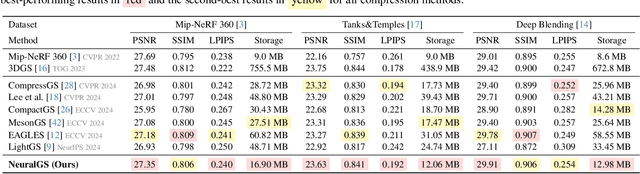
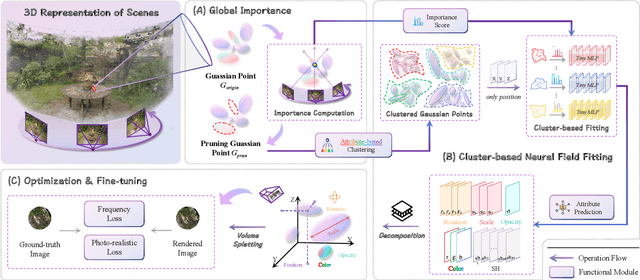
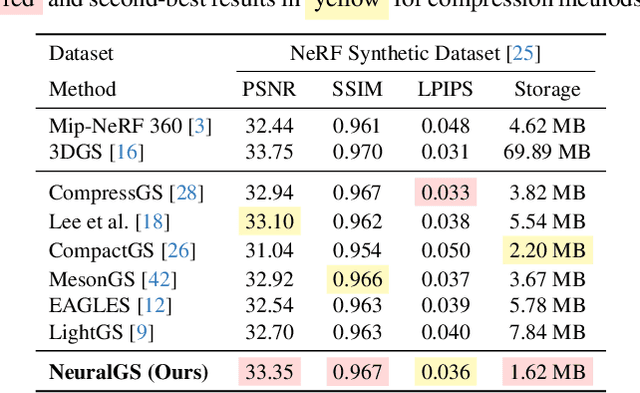
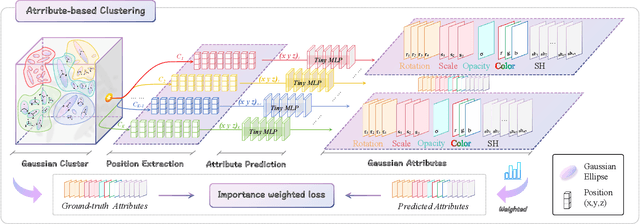
3D Gaussian Splatting (3DGS) demonstrates superior quality and rendering speed, but with millions of 3D Gaussians and significant storage and transmission costs. Recent 3DGS compression methods mainly concentrate on compressing Scaffold-GS, achieving impressive performance but with an additional voxel structure and a complex encoding and quantization strategy. In this paper, we aim to develop a simple yet effective method called NeuralGS that explores in another way to compress the original 3DGS into a compact representation without the voxel structure and complex quantization strategies. Our observation is that neural fields like NeRF can represent complex 3D scenes with Multi-Layer Perceptron (MLP) neural networks using only a few megabytes. Thus, NeuralGS effectively adopts the neural field representation to encode the attributes of 3D Gaussians with MLPs, only requiring a small storage size even for a large-scale scene. To achieve this, we adopt a clustering strategy and fit the Gaussians with different tiny MLPs for each cluster, based on importance scores of Gaussians as fitting weights. We experiment on multiple datasets, achieving a 45-times average model size reduction without harming the visual quality. The compression performance of our method on original 3DGS is comparable to the dedicated Scaffold-GS-based compression methods, which demonstrate the huge potential of directly compressing original 3DGS with neural fields.
AnyDexGrasp: General Dexterous Grasping for Different Hands with Human-level Learning Efficiency
Feb 23, 2025We introduce an efficient approach for learning dexterous grasping with minimal data, advancing robotic manipulation capabilities across different robotic hands. Unlike traditional methods that require millions of grasp labels for each robotic hand, our method achieves high performance with human-level learning efficiency: only hundreds of grasp attempts on 40 training objects. The approach separates the grasping process into two stages: first, a universal model maps scene geometry to intermediate contact-centric grasp representations, independent of specific robotic hands. Next, a unique grasp decision model is trained for each robotic hand through real-world trial and error, translating these representations into final grasp poses. Our results show a grasp success rate of 75-95\% across three different robotic hands in real-world cluttered environments with over 150 novel objects, improving to 80-98\% with increased training objects. This adaptable method demonstrates promising applications for humanoid robots, prosthetics, and other domains requiring robust, versatile robotic manipulation.